
Written by: Asım Kılınç, Esq., Immigration Attorney, Clinch Law Firm
You spent weeks gathering documents, carefully filled out the DS-160 form, paid the high visa fees, and went to the U.S. Consulate with excitement on the day of your interview. However, after a brief one- or two-minute conversation with the consular officer, your passport was handed back to you along with a standard printed letter. On that paper, a cold legal term was written: “Your application has been denied under section 214(b) of the INA.”
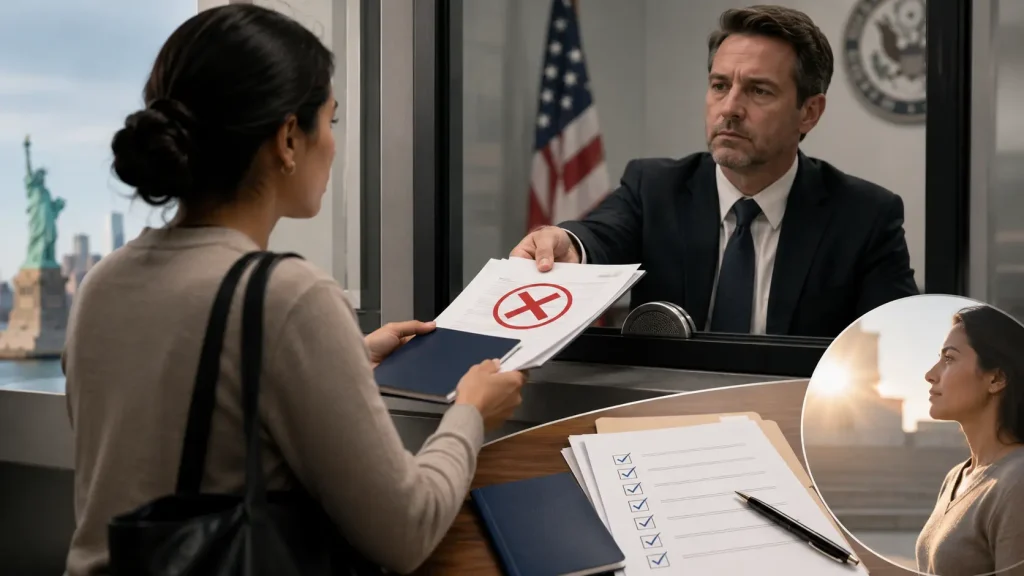
Many applicants experience profound disappointment and anger when they receive this refusal letter. Due to the vast amount of misinformation on the internet, they fall for baseless urban legends such as “The officer just didn’t like me,” “They didn’t even look at the money in my bank account,” or “Their visa quotas must be full.” The reality is entirely different. U.S. immigration law operates on very strict, well-defined statutory mandates, not on the personal preferences of the officers.
If your visa was denied under Section 214(b), it does not mean you can never travel to the United States again. It simply means that, based on your circumstances on that specific day, the officer did not find you eligible to travel as a “temporary visitor or student.” In this comprehensive guide, we explore what Section 214(b) actually means, what the consular officer is truly evaluating during your refusal, and the strategic legal steps you must take to secure an approval on your next application.
What Does INA Section 214(b) Actually Mean?
Section 214(b) of the Immigration and Nationality Act (INA) is the core legal standard governing the adjudication of all temporary visas (Tourist, Student, Exchange, etc.). The law states very clearly:
“Every alien shall be presumed to be an immigrant until he establishes to the satisfaction of the consular officer, at the time of application for a visa… that he is entitled to a nonimmigrant status.”
In simple terms, when the consular officer is reviewing your file, their default legal mindset is: “This individual is actually traveling to the U.S. to stay, work illegally, or immigrate.” The officer does not have to prove that you have bad intentions; U.S. law places the Burden of Proof entirely on you, the applicant. If you cannot convince the officer that you have compelling reasons to return to your home country once your visit is over, the officer is legally required to issue a “214(b) Immigrant Intent” denial.
3 Critical Deficiencies That Lead to Visa Refusals
Many applicants ask, “I had plenty of money in my bank account, why was I rejected?” Money is not everything. Consular officers look for “Strong Ties” to your home country that would compel you to return. Here are the 3 major deficiencies that most commonly trigger a 214(b) denial:
1. Weak Economic and Social Ties
The officer wants to see that your life in your home country is much more valuable than starting over as an undocumented immigrant in the United States. If you lack a stable, well-paying job, have a weak employment history, do not own property (like a house or car), or are young and unmarried, the officer will likely conclude that you do not have sufficient reasons to return home.
2. Inconsistent or Illogical Purpose of Travel
Why are you going to America? If your answer is simply “for a tourist trip,” but you have never traveled abroad before (especially to places requiring visas, like the Schengen area or the UK), the officer will find this highly suspicious. Similarly, if you have a full-time job in your home country but state, “I am going to a language school in New York for 6 months,” the officer will logically ask, “How did your employer give you 6 months of leave? This contradicts the normal flow of life,” and will assume your true intent is to work in the U.S.
3. DS-160 Form Errors and Interview Mismatch
Many people fill out the DS-160 form carelessly or use unauthorized third-party agencies. The visa interview actually begins before you step up to the window—when the officer reviews your DS-160 on their screen. If the salary listed on your form does not match what you say during the interview, or if you wrote you will stay for “2 months” on the form but say “1 week” in person, the officer will doubt the sincerity of your intent and issue a 214(b) refusal.
The Biggest Mistake After a Denial: Reapplying Immediately
The most common and costly mistake made by applicants after a refusal is aggressively paying a new visa fee right outside the consulate and booking another appointment for the following week out of frustration.
U.S. immigration laws do not prevent you from “trying your luck again”; you can apply as many times as you want. However, if there has not been a “Material Change” in your circumstances, the result will be another rejection. The new officer will see your previous refusal on their screen and will ask: “What has changed in your life since your application last month?”
Simply presenting a new bank statement or an invitation letter does not count as a material change. Accumulating Serial Refusals flags your profile in the system as someone “desperately trying to get to the U.S.,” essentially destroying your chances of future approvals.
📊 Table: Unsuccessful vs. Successful Application Strategy
To overcome a 214(b) denial, you can review how a “High-Risk” profile must be transformed into a “Credible” profile for your next application in the table below:
| Evaluation Criteria | Denied (High-Risk) Application Profile | Approved (Credible) Application Profile |
| Travel History | Passport is completely blank; first international trip is intended for the U.S. | Has previously traveled to the UK, Schengen area, or Asia and returned without overstaying. |
| Employment & Income | Just started a new job, gaps in employment history, receives salary in cash. | At least 1-2 years of seniority at the current employer, high and consistent salary deposited into a bank. |
| Travel Plan | “I want to tour America, I might stay for 2-3 months.” (Too vague). | “I will attend a specific industry expo in New York, my company is sending me, I will stay for 5 days and return.” |
| DS-160 Form | Filled out by an agency using standard, memorized, or incomplete phrases. | Prepared meticulously with an attorney, outlining the applicant’s true situation strategically. |
Frequently Asked Questions (FAQ): 214(b) Visa Refusals
1. Does getting a 214(b) denial mean I can never travel to the U.S. again?
Absolutely not. A 214(b) refusal is not a permanent ban or penalty. It simply indicates that, based on your current circumstances, you could not overcome the presumption of immigrant intent on that specific day. Once your family ties, employment, or financial situation improve, you can reapply and secure an approval.
2. The officer didn’t even look at my documents (like my bank statements). Why?
This is one of the most common complaints. However, the U.S. Consulate is not “document-driven”; it is “profile and testimony-driven.” The officer has already analyzed 80% of your profile based on the data in your DS-160 form (age, marital status, employment). They use 2-3 questions during the interview to test your intent. If your overall profile is illogical, the officer does not even need to look at the million dollars in your account or your property deeds.
3. Can I officially appeal a 214(b) visa denial?
No. Under U.S. law, visa refusals issued by consular officers under 214(b) are final (Doctrine of Consular Nonreviewability). You cannot take this decision to a U.S. court or appeal to a higher authority. Your only solution is to address your deficiencies and file a completely new application.
4. Will my chances increase if I suddenly deposit a large sum of money into my account?
This is a major strategic error. Officers easily spot “funds parking”—unexplained, large sums of borrowed money deposited into an account just days before the interview. Instead of giving you an advantage, this raises immediate suspicion that you are trying to “deceive the officer,” leading directly to a denial. Funds must reflect a steady accumulation of legitimate income over months.
5. Does an Invitation Letter guarantee I will get the visa?
No, an invitation letter holds no legal weight. In some cases, it can actually be harmful. If a relative in the U.S. sends you an invitation, the officer might think, “They have a place to stay and a support system there; the groundwork is laid for them not to return,” making your file riskier. What matters is not who is inviting you, but the strong ties you have compelling you to return home.
6. Will a 214(b) refusal affect my future Green Card application?
No. A 214(b) denial indicates you were found ineligible for a “Temporary” (Nonimmigrant) status because the officer believed you had “Immigrant” (Permanent) intent. If you apply for an actual Green Card in the future—such as through an EB-2 NIW, EB-5, or Family sponsorship—your past 214(b) tourist visa refusal will not negatively impact those immigrant petitions.
Conclusion: A Denial Is Not the End; It Is a Lack of Strategy
While receiving a 214(b) refusal from the U.S. Consulate is discouraging, it is not the end of your legal journey. Most of the time, these refusals occur not because the applicant is unqualified, but because they fail to articulate their intent and their strong home-country ties in the “legal language” understood by the U.S. immigration system.
Going back to the consulate repeatedly with the same documents, the same excuses, and the same weak DS-160 form will only ruin your immigration record. To achieve success on your next application, you must objectively analyze why you were denied, wait for your circumstances to genuinely improve, and structure your reapplication strategy with an expert immigration attorney rather than relying on unauthorized third-party agencies.
To learn more about U.S. visa types, you can explore our Blog page, or reach out to us via our Contact page for a free preliminary evaluation of your case. You can follow the latest updates and developments regarding U.S. immigration on our News page.
⚖️ References and Legal Basis
The visa refusal grounds, the Presumption of Immigrant Intent rule, and consular interview standards in this guide are based on the following federal laws:
- INA Section 214(b) – Presumption of Immigrant Intent: The fundamental U.S. immigration statute mandating that every alien shall be presumed to be an immigrant until they establish to the satisfaction of the consular officer that they are entitled to a nonimmigrant status.
- U.S. Department of State – 9 FAM 401.1-3(F): The official Foreign Affairs Manual detailing how consular officers must evaluate an applicant’s “Ties to Home Country” (family, employment, and property) during a 214(b) adjudication.
- Doctrine of Consular Nonreviewability: A long-standing federal jurisprudence rule stating that a consular officer’s decision to deny a visa (especially under 214b) is not subject to judicial review or appeal in U.S. courts.
Visa Refusal & Reapplication Analysis
Don’t Make Mistakes After a 214(b) Denial
Was your U.S. visa denied? Before risking your file completely by repeating the same errors, evaluate your refusal grounds and build a solid reapplication strategy safely with Attorney Asım Kılınç.
CONTACT US TO REVIEW YOUR CASE