
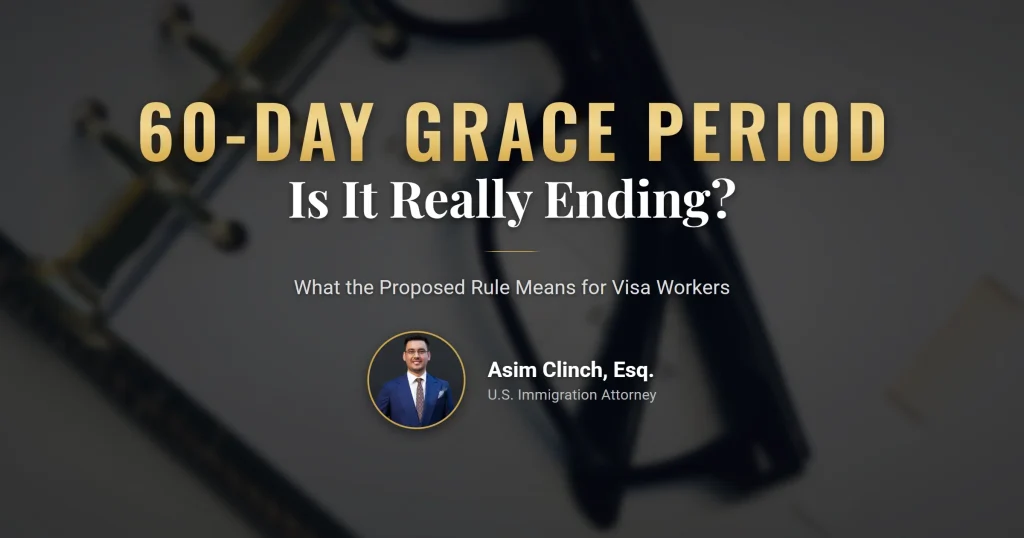
The 60-day grace period is a discretionary window available under current regulations after employment or an approved activity ends for certain nonimmigrant workers. The rule published on September 11, 2026 did not eliminate that window immediately. DHS and USCIS proposed its removal. Therefore, the existing regulation remains in place unless and until a final rule takes effect.
| Bottom line: As of September 16, 2026, this is a proposed rule, not a final rule. Public comments are due by 11:59 p.m. Eastern Time on November 10, 2026. |
What would the 60-day grace period proposal change?
DHS proposes to remove 8 CFR 214.1(l)(2). If finalized as written, the change would end the discretionary post-employment period for the listed classifications. A person with no other lawful basis to remain could be treated as failing to maintain status on the day after the qualifying employment or activity ends. The proposal also recognizes possible income, travel, and refiling costs for workers and dependents.
The phrase “up to 60 days” already matters under current law. The period is not an automatic guarantee. It cannot extend beyond the authorized stay shown on Form I-94, and DHS may shorten or eliminate it as a matter of discretion. Consequently, workers should not plan around a guaranteed 60-day runway even before any final rule.
Which visa classifications are covered?
| Status | Typical use | Treatment in proposal |
|---|---|---|
| E-1 / E-2 / E-3 | Treaty trade/investment; Australian specialty work | Principals and dependent family members are addressed |
| H-1B / H-1B1 | Specialty occupation employment | Current post-employment window would be removed |
| L-1 | Intracompany transfer | Principal and dependent status may be affected |
| O-1 | Extraordinary ability or achievement | End of approved work or activity becomes critical |
| TN | Canadian and Mexican professionals | The same risk follows termination of qualifying work |
The proposal expressly lists E-1, E-2, E-3, H-1B, H-1B1, L-1, O-1, and TN classifications. It does not revise the separate post-completion rules for F-1 students or J-1 exchange visitors. In addition, each covered classification keeps its own rules on employment authorization and employer changes.
Has the rule changed today? Proposal versus final rule
No. A Notice of Proposed Rulemaking opens a regulatory process. After reviewing public comments, DHS may revise the text, withdraw it, or publish a final rule. Any final rule would state an effective date. Thus, headlines saying that USCIS “ended” the period are legally premature as of September 16, 2026.
The official docket is USCIS-2026-0364. A useful comment should be in English, identify the relevant portion of the proposal, and include supporting facts, data, or authority. Comments and personal information may become public, so contributors should limit unnecessary personal details.
What should a worker do after job loss now?
- Confirm the last day of qualifying employment and the Form I-94 expiration date immediately. A notice date, payroll date, and actual last day may differ.
- Evaluate a new employer petition, change of status, extension, adjustment of status, or another available path early. A filing does not always preserve work authorization.
- Submit the correct form, fee, signature, and required initial evidence on time. Keep proof of delivery and the receipt notice.
- Review each dependent’s H-4, L-2, E dependent, or other status separately. A change to the principal’s status can affect the family.
- Do not begin or continue work based only on a pending filing. The right to work depends on the classification and filing type.
USCIS identifies several possible paths after termination, including a new employer filing, change of status, adjustment of status, and, for some people, compelling-circumstances employment authorization. Still, eligibility, timing, and employment authorization are fact-specific.
Practical issues for employers
Employers should treat termination as both an employment and immigration event. For some H-1B and O-1 terminations, the employer may have obligations concerning the reasonable cost of return transportation. Petition withdrawal, payroll records, the last day worked, and any new employer start date should also align.
A prospective employer should not merely assume that a candidate remains inside a grace period. It should review the person’s status document, Form I-94, prior approval, last day of work, and the USCIS filing date together.
Frequently asked questions
Did the 60-day period end on September 11, 2026?
No. DHS published a proposed rule on that date. The current regulation remains effective unless a final rule changes it.
Does everyone receive a full 60 days today?
No. The regulation provides up to 60 days, cannot extend beyond the I-94 end date, and remains discretionary. Other status violations may change the analysis.
Can I start work as soon as I find a new employer?
It depends on the classification and filing. H-1B portability may allow some workers to start after a qualifying filing, while other classifications may require approval first.
Does submitting a public comment protect my status?
No. A public comment is part of rulemaking, not an individual immigration filing. It does not extend status or authorize employment.
Legal information notice
This article provides general information as of September 16, 2026. The regulatory change remains a proposal. Status, Form I-94 dates, termination facts, filing strategy, and dependent circumstances vary. A qualified U.S. immigration lawyer should review individual cases.