
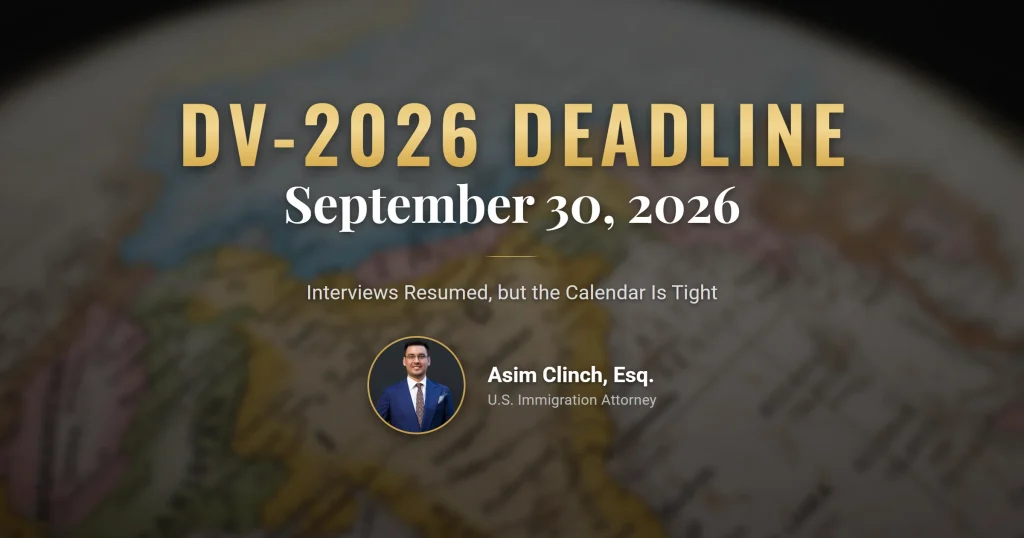
Short answer: DV-2026 selectees lose the right to receive a visa after September 30, 2026. That date is not an administrative target. It is written into the statute. This year the process was also disrupted by a pause on DV visa issuance. A federal court blocked that pause in August 2026, and on September 10 the State Department instructed all posts to rescind it entirely.
Interviews are being held again and visas are being issued. The calendar, however, is extremely tight. This article covers what can still be done, what happens after September 30, and where DV-2027 and DV-2028 stand.
What you will find in this article
- The legal basis for the September 30 deadline
- Why issuance was paused and what the court ruling changed
- What the September 10 instructions require of consular posts
- The situation for selectees from Turkey, processed in Ankara
- Whether eligibility survives past September 30
- What is known today about DV-2027 and DV-2028
Quick overview: where DV-2026 stands
| Question | Short answer |
|---|---|
| When is the deadline? | September 30, 2026. No DV-2026 visa may be issued after that date. |
| Is issuance still paused? | No. The pause was rescinded in full by instructions dated September 10, 2026. |
| Are interviews happening? | Yes. Posts are scheduling interviews and issuing visas again. |
| Is Turkey included? | Yes. Turkey is an eligible country and interviews are held in Ankara. |
| What happens after September 30? | DV-2026 selection expires. Numbers do not carry into the next fiscal year. |
| Is DV-2027 registration open? | No. The registration period was delayed and has not opened. |
Why September 30 is a hard deadline
Under the immigration statute, selectees remain eligible to receive a visa only through the end of the fiscal year for which they were selected. The U.S. fiscal year ends on September 30. The rule appears at 8 U.S.C. 1154.
The State Department states in the September 2026 Visa Bulletin that the year of entitlement for all DV-2026 applicants ends as of September 30, 2026, and that DV visas may not be issued after that date. The DV-2026 selected entrants page likewise notes that selectees who do not receive a visa or status by September 30, 2026 derive no further benefit from their registration.
Unused numbers do not carry over.
What happened this year: the pause and the court ruling
The process stalled at the end of 2025. In December 2025, USCIS placed DV-based adjustment cases on hold. In the same period, the State Department instructed posts to refuse DV applicants under section 221(g). In January 2026, a separate immigrant visa pause began for nationals of 75 countries.
These measures went to court:
- August 28, 2026: in Medani v. Trump, the U.S. District Court for the Northern District of California granted class certification and a preliminary injunction covering DV-2026 selectees and their derivatives, and blocked the policies. The docket is available on CourtListener.
- September 4, 2026: USCIS announced that it disagreed with the order but would follow it.
- September 10, 2026: the State Department instructed all embassies and consulates to rescind the DV and 75-country pauses in full.
What the September 10 instructions require
According to the text the government filed with the court:
- The earlier pause instructions are rescinded in their entirety. No applicant may be refused under 221(g) on that basis.
- Refusals based solely on the pauses must be reviewed, starting with the oldest.
- Missing documents, including updated medical examinations where needed, will be requested in writing.
- Applicants may be reinterviewed where necessary.
- Posts must prioritize DV-2026 applicants whose interviews were originally scheduled between August 23 and September 30, 2026 but were rescheduled.
That priority matters directly for selectees from Turkey whose appointments were moved.
A note on the State Department’s page
The State Department’s DV guidance page carries a notice about the court order, but the older pause text is still on the page. Some outlets read that as a new pause. The instructions and the interviews now taking place show that the pause has been lifted. Read the court-order notice at the top of that page.
What this means for selectees from Turkey
- Turkey is an eligible country for DV-2026 and sits in the Europe region.
- DV cases from Turkey are processed at the U.S. Embassy in Ankara.
- The September 2026 bulletin set the Europe regional cut-off at rank 47,500. A case number below that threshold is within range for an interview.
- The embassy’s DV instructions also state that no visa can be issued after September 30 under any circumstances.
What can still be done in the final two weeks
If your case is at a consulate
- Confirm that Form DS-260 is complete. An incomplete form prevents scheduling.
- Check your appointment status. Posts are contacting applicants, but follow up rather than waiting.
- Keep documents current. Medical examinations, police certificates, and passport validity are critical.
- If you received a 221(g) refusal, read the basis. If it rests solely on the pause, your case is being reviewed.
- Prepare family members’ documents together. A spouse’s and children’s eligibility also ends on September 30.
If you are in the United States and filing for adjustment
- The USCIS hold on DV cases has been lifted and adjudication resumed.
- Your adjustment application must be approved by September 30, 2026. A pending application is not enough.
- Expedite requests are possible, but the criteria are narrow and there is no guarantee.
What happens after September 30?
The answer is clear: DV-2026 eligibility ends. In earlier years, some courts ordered unused visa numbers to be reserved. In 2024, however, the court of appeals held that district courts had no authority to order the State Department to keep processing diversity visa applications beyond the end of the relevant fiscal years, and that once those years ended, the plaintiffs lost eligibility.
Planning on the assumption that the process will simply continue is therefore not advisable.
DV-2027 and DV-2028
- DV-2027: the registration period was delayed and has not opened. The State Department announced that the visa application period for those eventually selected would run from October 1, 2026 to September 30, 2027. As of September 18, 2026, no new registration schedule had been announced.
- DV-2028: no official registration period has been announced. Dates circulating online do not come from an official source.
We covered the wider picture in our article on the DV-2028 lottery and in our article on the 75-country policies.
Common mistakes
- Treating September 30 as a flexible target
- Reading the older text on the State Department page as a new pause
- Letting documents expire while waiting for an appointment
- Filing something new without reading the basis of a 221(g) refusal
- Assuming a pending adjustment application is enough
- Planning around unofficial DV-2027 or DV-2028 dates
Short checklist
- Is my DS-260 complete?
- Is my case number below the September Europe cut-off?
- Do I have my appointment notice or 221(g) letter?
- Are my medical exam and police certificate valid through September 30?
- Are my family members’ documents ready?
- If I am in the United States, what is the status of my adjustment application?
Frequently Asked Questions
When is the DV-2026 deadline?
September 30, 2026. No DV-2026 visa may be issued after that date.
Is DV issuance still paused?
No. The pause was rescinded in full by instructions dated September 10, 2026, and posts are interviewing again.
My interview was cancelled. Can I get a new one?
The instructions direct posts to prioritize DV-2026 applicants whose interviews were scheduled between August 23 and September 30 and then rescheduled. Posts are contacting applicants, but follow up as well.
I received a 221(g) refusal. What should I do?
Check the basis. If it rested solely on the pause, your case is being reviewed. If something else is missing, submit it immediately.
Does my eligibility continue after September 30?
No. When the fiscal year ends, DV-2026 eligibility ends and numbers do not carry over.
I am in the United States with a pending adjustment application. Is that enough?
No. The application must be approved by September 30, 2026.
When will DV-2027 registration open?
The registration period was delayed and had not opened as of September 18, 2026. An official announcement is required.
Is Turkey eligible for the DV program?
Turkey is eligible for DV-2026. Eligibility is recalculated each year, so DV-2027 and DV-2028 require official confirmation.
Conclusion: a tight calendar and complete documents
Less than two weeks remain for DV-2026. The pause has been lifted and interviews have resumed, but posts are working through a large backlog. What makes the difference now is having complete, current documents and following consular communications closely.
To review where your case stands and what can still be done, contact Clinch Law.
Legal information notice
This content is provided for general information only. It does not create legal advice, an attorney-client relationship, or a guarantee of any outcome. DV processing depends on case number, region, the documents in the file, and consular capacity. Related litigation is ongoing. Legal information checked on: September 18, 2026.