
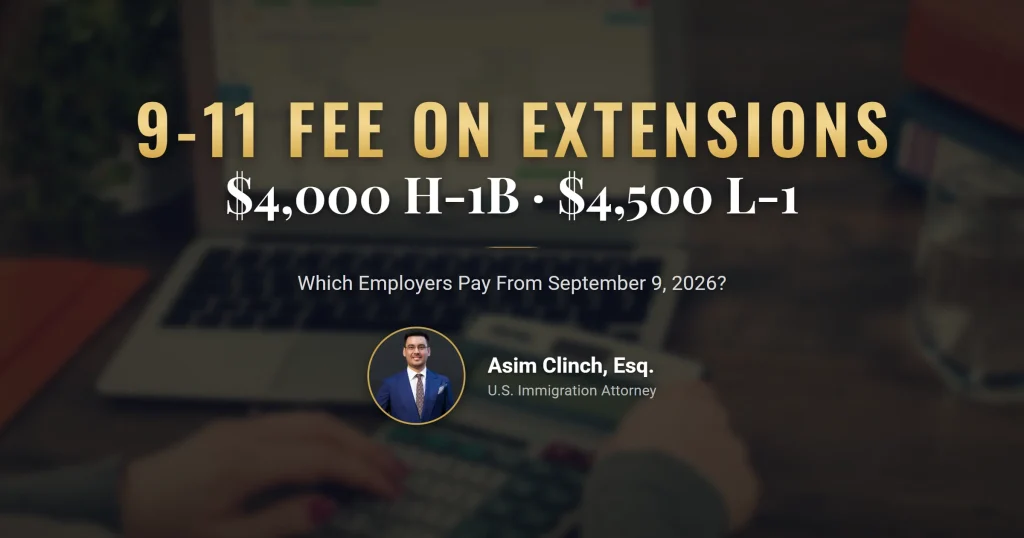
Short answer: starting September 9, 2026, employers with 50 or more employees in the United States, more than half of whom hold H-1B, L-1A, or L-1B status, must pay the 9-11 fee on extension petitions for the same employee as well. The fee is $4,000 for H-1B and $4,500 for L-1.
Most employers are not affected. A company with fewer than 50 U.S. employees, or one whose share of H-1B and L-1 workers does not exceed 50 percent, does not pay this fee. Many small and mid-sized U.S. subsidiaries of Turkish companies fall outside the rule for exactly that reason.
If your company is still assessing an intracompany transfer, start with the basic L-1 visa requirements for companies opening a U.S. branch.
What you will find in this article
- What the 9-11 fee is and which petitions paid it before
- How to calculate whether your company meets the 50/50 test
- How extensions, amended petitions, and pending petitions are treated
- Why this fee should not be confused with the $100,000 H-1B payment
Quick overview: the 9-11 fee and extensions
| Question | Short answer |
|---|---|
| What changed? | Covered employers now pay the fee on same-employer extensions too. |
| Since when? | The rule took effect on September 9, 2026. |
| How much? | $4,000 for H-1B and $4,500 for L-1A and L-1B. |
| Who pays? | Employers with 50 or more U.S. employees, more than 50 percent of whom are in H-1B or L-1 status. |
| Are pending petitions affected? | No. The rule does not apply retroactively or to pending petitions. |
| How long does the fee last? | For petitions filed on or before September 30, 2027, unless Congress extends it. |
What is the 9-11 fee?
The 9-11 Response and Biometric Entry-Exit Fee is a special fee created by Congress. The Consolidated Appropriations Act, 2016 established it for large employers whose workforce is mostly in H-1B or L-1 status. The revenue funds 9-11 response programs and the biometric entry-exit system.
The fee is added on top of the base filing fee and the $500 Fraud Prevention and Detection Fee. It does not replace any existing filing cost.
Which petitions paid the fee before?
In practice, the 9-11 fee followed the $500 Fraud Fee. That generally meant:
- Petitions seeking an initial grant of H-1B or L-1 status
- Petitions involving a change of employer
An extension for an L-1A manager or H-1B worker staying with the same employer did not trigger the fee. That is the gap the new rule closes.
What did the September 9, 2026 rule change?
The Department of Homeland Security, acting through U.S. Customs and Border Protection, published the final rule in the Federal Register on August 10, 2026. It took effect on September 9, 2026. DHS first proposed the change in June 2024.
Under the rule, covered employers pay the 9-11 fee on all of the following:
- Petitions seeking initial H-1B or L-1 classification
- Petitions involving a change of employer
- Extension petitions to remain employed with the same employer
The current regulatory text now appears at 8 CFR 106.2. DHS explains that this reading follows the statute’s reference to applications “including an application for an extension of such status.”
Is your company covered? The 50/50 test
An employer pays the fee only if both conditions are met:
- The employer has 50 or more employees in the United States.
- More than 50 percent of those employees, in the aggregate, are in H-1B, L-1A, or L-1B status.
A few details matter:
- H-1B and L-1 workers are counted together. For example, 20 L-1A workers and 12 H-1B workers count as 32 employees in covered status.
- Full-time and part-time employees both count. DHS says the words “in the aggregate” were added to clarify its existing practice.
- Exactly 50 percent is not enough. The share must exceed 50 percent.
- Employees of the foreign parent company do not count. The test looks at the petitioner’s employees in the United States.
Sample calculations
| U.S. workforce | Result |
|---|---|
| 60 employees, 31 in H-1B or L-1 status (51.7 percent) | Covered. An L-1A extension adds $4,500 and an H-1B extension adds $4,000. |
| 60 employees, 30 in H-1B or L-1 status (exactly 50 percent) | Not covered. The share does not exceed 50 percent. |
| 48 employees, 40 in L-1 status | Not covered. Fewer than 50 U.S. employees. |
| New branch with 12 employees, 3 L-1A managers | Not covered. A typical new office stays below both thresholds. |
If you operate several related U.S. companies, how employees are counted should be reviewed separately. The rule does not set out a detailed method for affiliated entities.
Which petitions are exempt?
- Amended petitions that do not request an extension. According to the rule, an amended petition that does not seek to extend the worker’s currently authorized status does not owe the fee. If the amendment also requests an extension, the fee applies.
- Petitions filed before the rule took effect and still pending. DHS states that the fee does not apply retroactively or to pending petitions.
- Every petition from an employer that is not covered. An employer that fails the 50/50 test does not pay this fee on initial petitions or on extensions.
Individual L-1 petitions filed under an approved blanket L were already treated as subject to the fee. DHS states that current practice does not change for them.
Is this the same as the $100,000 H-1B payment?
No. These are separate measures:
- The 9-11 fee is a statutory fee of $4,000 or $4,500 paid only by employers that meet the 50/50 test. It applies to petitions filed on or before September 30, 2027.
- The $100,000 H-1B payment comes from a September 2025 presidential proclamation and is expected to end on September 21, 2026. We covered the latest developments in our article on the end of the $100,000 H-1B payment.
- The new $103,265 proposal was proposed on August 25, 2026 for cap-subject H-1B petitions only and is not final.
Cost planning: what should employers do now?
Extension planning is now a budget issue for covered employers. Ten L-1 extensions over the next 12 months would add $45,000 in 9-11 fees alone.
- Count your workforce as of the filing date. The ratio can change during the year, so check it before each petition.
- Map upcoming extensions. List when each worker’s status expires and add the total cost to the annual budget.
- Confirm the current form edition and fee schedule. Before filing, check USCIS’s Form I-129 page and the G-1055 fee schedule. A missing fee can lead to rejection or delay.
- Consider long-term options. For executives and managers who transferred on L-1A, moving from L-1A to an EB-1C green card can reduce repeated extension costs.
Common mistakes
- Treating exactly 50 percent as covered
- Counting H-1B and L-1 workers separately and missing the combined ratio
- Adding the foreign parent company’s employees to the U.S. count
- Paying the fee on an amended petition that does not request an extension
- Confusing the 9-11 fee with the $100,000 H-1B payment
- Assuming extra money must be sent for a petition that was already pending
Short pre-filing checklist
- Does the company have 50 or more employees in the United States?
- Do H-1B, L-1A, and L-1B workers together exceed 50 percent of that workforce?
- Is the petition an initial filing, a change of employer, an extension, or an amendment without an extension?
- Will the petition be filed on or after September 9, 2026?
- Have the current form edition and fee schedule been confirmed?
- Has the cost of other extensions this year been added to the budget?
Frequently Asked Questions
Does every company pay the $4,500 fee on an L-1 extension?
No. Only employers with 50 or more U.S. employees, more than half of whom are in H-1B or L-1 status, pay it.
We have a small U.S. subsidiary. Does this change affect us?
If the subsidiary has fewer than 50 employees, the fee does not apply. Most newly established offices are below that threshold.
Do we owe the fee for an extension filed before September 9?
No. DHS states that the fee does not apply retroactively or to pending petitions.
Are H-1B and L-1 workers counted separately?
No. The ratio is based on the combined number of H-1B, L-1A, and L-1B workers.
Is the fee owed at exactly 50 percent?
No. The rule requires more than 50 percent. If 30 of 60 employees hold covered status, no fee is due.
Does an amended petition trigger the fee?
Not if the amended petition does not extend the worker’s status. If it also requests an extension, the fee applies.
Can we pass this fee on to the employee?
The fee is paid by the employer with its petition. Rules on passing employer costs to workers, especially for H-1B, are separate, so employers should get legal advice before doing so.
Is the 9-11 fee permanent?
No. Under the current regulation, it applies to petitions filed on or before September 30, 2027. It will end then unless Congress extends it.
Conclusion: the fee targets large, visa-heavy employers
The September 9, 2026 rule extends the 9-11 fee to same-employer H-1B and L-1 extensions. It affects only employers that meet the 50/50 test, and many small and mid-sized U.S. subsidiaries of Turkish companies remain outside it. For covered employers, extension timing is now a direct budget item.
To review how the 50/50 test applies to your company and plan extensions for your L-1A, L-1B, or H-1B employees, contact Clinch Law.
Legal information notice
This content is provided for general information only. It does not create legal advice, an attorney-client relationship, or a guarantee of any outcome. Whether an employer owes the 9-11 fee depends on its U.S. headcount, the status of its employees, and its corporate structure on the filing date. Legal information checked on: September 17, 2026.